Use this page to help guide you through submitting a complete application. We will explain when you need a permit, what permits you need, what your application requirements are and go over some common rules relating to your project.
Additions
Permits, application requirements, and common rules
This page outlines the steps for applying to renovate an existing building which results in increasing the building’s external dimensions in any manner.
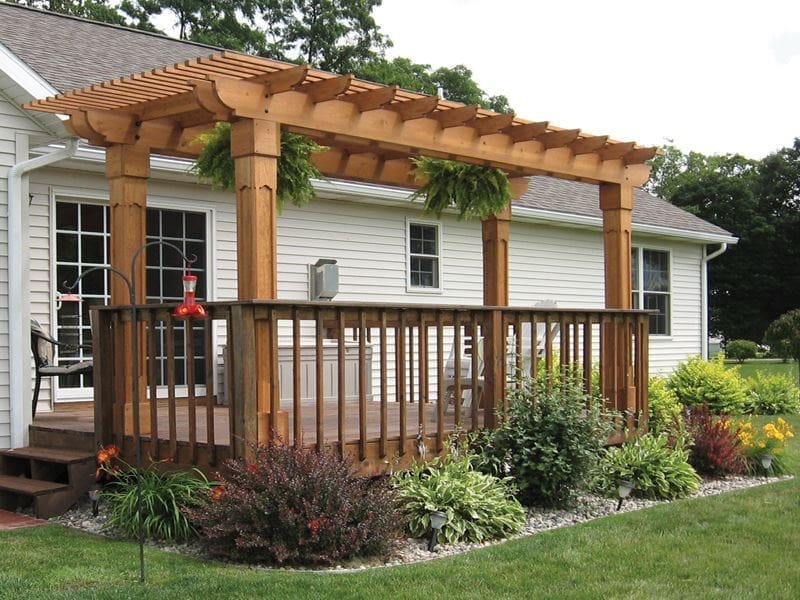
Examples include attached garages and carports, sunrooms, covered decks, and pergolas.
You’ll learn:
- When a building or development permit is required
- What documents and drawings you need
- Common regulations and review timelines
Before Applying
Do you need a permit?
Yes. All additions to your home will always require at least a building permit. An addition is any construction that increases the area of your home, and includes any covered structure, such as a covered deck or porch, attached garage, sunroom, etc.
- If you are replacing or rebuilding some existing exterior walls, this would be included as part of your addition and must clearly be indicated in your submission.
- If you are replacing or rebuilding all the exterior walls, this is considered a new house, and all applicable permits are required. Visit the New Residential Permits page for the application package for a new house.
Permit Types
Building Permit
Building safety approval is to make sure that the structure meets building safety requirements. For building code questions or assistance, email inspections@chestermere.ca or call 403-207-7075 and ask to be connected to a Building Safety Codes Officer (BSCO).
When do you need additional permits?
You may require additional permits if you are doing any additional work including electrical or plumbing.
You need a separate electrical permit for all electrical installations and renovations.
If you are doing the work yourself, you may be eligible for a homeowners electrical permit.
If you are hiring someone to do the work for you, they will need to apply for the permit.
A separate plumbing permit is required for all new plumbing installations, as well as when extending or altering any existing plumbing systems.
Cost
| Building permit (building safety approval) | Fee Schedule | Permit fee | Safety codes council fee (4%) |
| Addition | Fee Schedule | Residential Cost Estimate (Exhibit A) | minimum $4.50 up to a maximum of $560 |
Development Review (Minor Residential – Permitted Use): $100 + $1.00/sq m
Trade Permit Fees – refer to Electrical and Plumbing Permit Fees Section in the fee schedule.
* permit fees may change from time to time (please refer to the fee schedule)
How to pay
Online
Submit your application with the credit card authorization form. If it’s missing, a staff member will contact you.
In person
Pay by credit/debit, cheque, or cash at City Hall. Credit card payments over $2500 are not accepted at this time.
How long does it take?
Timelines depend on:
- Application volume
- Completeness of your submission
- How quickly you respond to follow-up requests
Tip: To avoid delays, ensure all documents in the permit application are submitted.
Timeline
| Building permit (building safety approval) | Our process | Timeline |
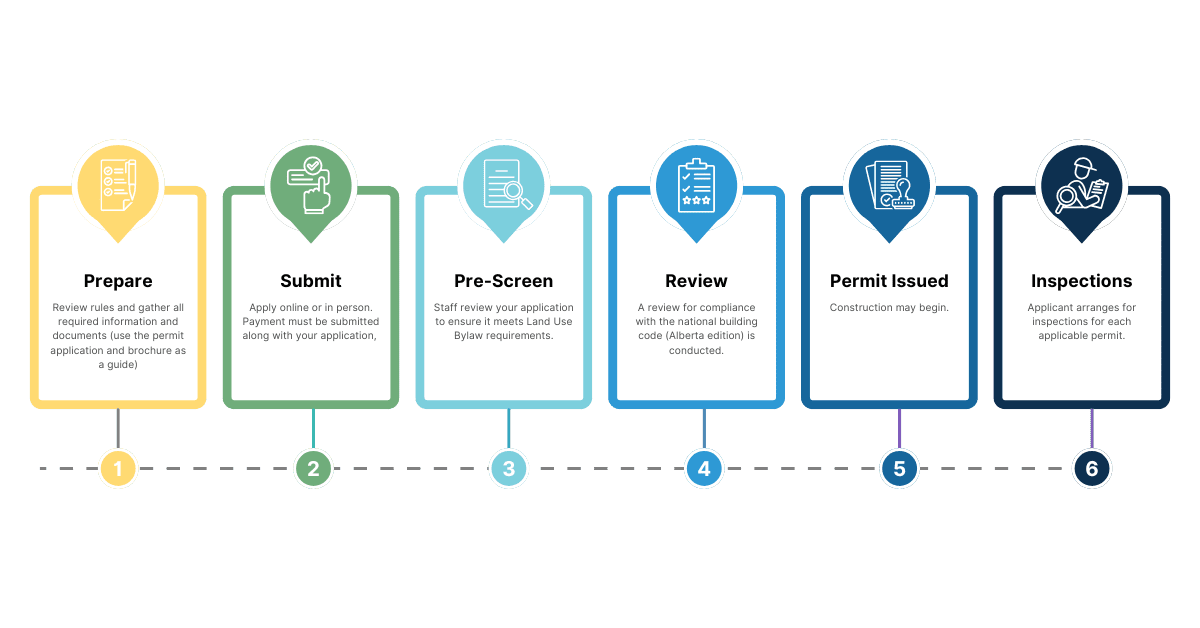
| New addition or changes to an existing addition. | Application is reviewed for land use and safety codes compliance | 7-10 business days |
Planning approval timelines
| Development permit (planning approval) if applicable | Our process | Timeline |
| Proposed structures that do not meet the rules of the Land Use Bylaw | 60 days to decision 21 days advertisement/appeal period | Approximately 10-12 weeks |
Preparing your application
Step 1: You will need to know
- Project address
- Applicant’s name (homeowner or representative)
- Who is doing the work (contractor or homeowner)
- What you are applying for
- Project details, including the size of the building
Owners’ authorization is required if not applied for by the owner.
Step 2: Prepare the Required Documents and Plans
- Specific drawing and supporting document requirements are listed on the permit checklist included on the application package. You must provide all the required drawings and documents when you submit your application.
Required plans
Plot Plan
A Plot Plan is a “bird’s eye” 2-D representation of a property and includes:
- the location and dimensions of property lines,
- structures on the property,
- rights-of-way
- other features unique to the property.
Tip: You can modify a Real Property Report (RPR) to use as your Plot Plan.
Floor Plans
- You will need to provide floor plans for each floor of your house (i.e. basement, main floor, second floor, etc) affected by the proposed addition.
- Label the purpose of how each room is used (i.e. kitchen, bathroom, bedroom, etc).
- Indicate the size, type and operation of all bedroom windows.
- Label and dimension any changes, including:
- Existing walls, doors and windows
- new doors and windows
- new walls
- new beams (if applicable)
Elevations
- An elevation drawing is a 2D view of the house’s exterior walls.
- You must provide elevations for all sides of the house affected by the addition. For example, if you are adding a front porch, you will need to provide the front and side elevations of the entire house, including the new addition, but you would not need to include the rear elevation.
- Indicate the locations and dimensions of all windows, doors and exterior stairs.
- You will need to provide elevation drawings of each side of the house.
Structural Cross-sections
- The cross-section is a 2-D interior view of what the house looks like inside.
- Your drawing should include the interior wall height, building height, all components of the wall, floor and roof assembly and the overall height of the new addition.
Manufacturer’s Floor Joist Layouts, Roof Layouts, and Beam Runs
- You can obtain these from the manufacturers.
Engineering Documents
- These are only required for construction not covered under the National Building Code – Alberta Edition.
Submitting your application
- Review the application checklist
- Ensure all documents are complete
- Use sample drawings to verify requirements
- Contact us if you have questions: 403-207-7075 | planning@chestermere.ca
What is a Complete Application?
Includes all required plans, forms, documents, and payment.
Note: As per the Municipal Government Act (MGA), “A development authority must, withing 20 days after the receipt of an application for a development permit, determine whether the application is complete. The development authority must make a decision on the application for a development permit within 40 days after it is deemed complete.”
Apply online
Email your completed permit application to: planning@chestermere.ca
Create or sign in to your online account:
Apply in person
Once you have downloaded the application form and gathered all required documentation, you can apply for your permit by visiting Development & Building Services.
Monday – Friday 8:30am – 4:30pm
2nd floor of City Hall,
105 Marina Road
After applying
Depending on the method used, all or some of the following may apply:
- You will receive a confirmation email
- Staff may contact you for additional information
- Respond quickly to avoid delays
Inspections
What Inspections Are Required?
Please refer to your plans examination/permit conditions attached to your issued permit.
How to Book an Inspection
Email: inspections@chestermere.ca
Subject Line: Request for Building Inspection – Addition – [Your Address]
Body: Provide inspection request details
A technician will follow up by email or phone.
E-Permit users can book inspections through their online account.
Making changes

To Your Application
Email: planning@chestermere.ca
Subject Line: Revisions – Addition – [Your Address]
Include a summary and revised drawings (clearly marked)
To Your Issued Permit
Email: inspections@chestermere.ca
Subject Line: Revisions – Addition – [Your Address]
Include the revised documents and a description of the changes
A revision fee may apply.
Other requests
Development & Building Services
Hours:
Monday – Friday
8:30 a.m. – 4:30 p.m.
Call:
403-207-7075
Email:
planning@chestermere.ca
In person:
Development & Building Services
2nd floor, City Hall
105 Marina Rd
Click before you dig
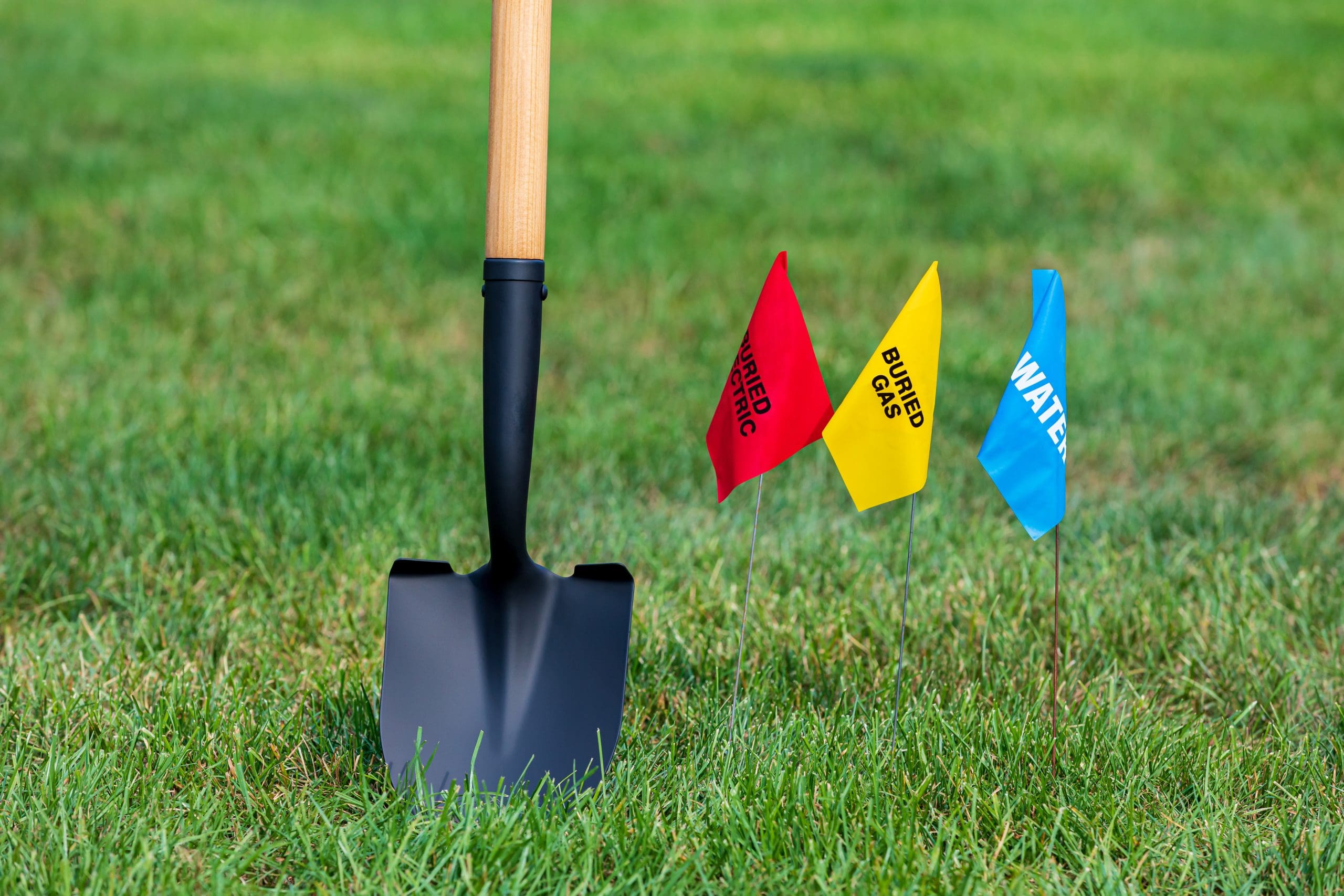
Before starting any digging project, make sure to reach out to Utility Safety Partners. You can submit a locate request online or get more information by calling 1-800-242-3447.